Style Drops
NRI Diwali Shopping Index 2026
What Diwali actually costs a US-based NRI buyer in 2026 — real price bands across 187 catalogued pieces, shipping cut-off maths, and the four categories nobody stocks.
NRI Diwali Shopping Index 2026
Every October the same question arrives in our inbox in slightly different words: what should I actually expect to spend? And every October the honest answer is harder to find than it should be, because the people publishing Diwali shopping guides are mostly the people selling the Diwali clothes.
So this is the version written from the catalogue side. Every number below is derived from the 187 pieces we have individually catalogued across House of Indya and Paksha as of 9 October 2026 — not from a survey, not from a market-size estimate, and not from anybody’s press release. Where we don’t have data, we say so.
The headline number
A complete Diwali look — outfit plus one piece of jewellery — starts at $62 and lands at $138 at the median.
That spread is the single most useful thing on this page, and the gap between the two numbers is the whole story. It is not driven by the clothes. It is driven almost entirely by what you put on top of them.
| Cheapest | Median | Most expensive | |
|---|---|---|---|
| Outfit (House of Indya, 84 pieces) | $27 | $46 | $123 |
| Jewellery (Paksha, 104 pieces) | $34.99 | $92.49 | $968 |
| Complete look | $62 | $138 | $1,091 |
The apparel catalogue is remarkably tight — 84 pieces spanning $27 to $123, with a median of $46. There is no luxury tier here because House of Indya does not operate one. You essentially cannot overspend on the outfit.
The jewellery catalogue behaves in the opposite way. Paksha’s 104 pieces run from $34.99 to $968 with a median of $92.49, because these are handcrafted 925 sterling silver with individually-set moissanite, kempu and jadau stones. The spread is wide because the catalogue holds two different things: 85 mangalsutras clustered low ($34.99–$339.99, median $74.99) and 19 statement pieces that climb steeply above them.
The practical consequence: if you are budgeting for Diwali, decide the jewellery number first. The outfit will cost what it costs, and it will not be very much.
Price bands by category
Apparel, all 84 House of Indya pieces, all currently in stock:
| Category | Pieces | Range | Median |
|---|---|---|---|
| Lehenga sets | 34 | $35 – $123 | $54 |
| Saree sets | 27 | $27 – $63 | $52 |
| Anarkalis | 11 | $28 – $107 | $37 |
| Salwar kameez | 5 | $28 – $41 | $35 |
| Kurta sets | 4 | $29 – $33 | $31 |
| Sharara sets | 3 | $29 – $38 | $32 |
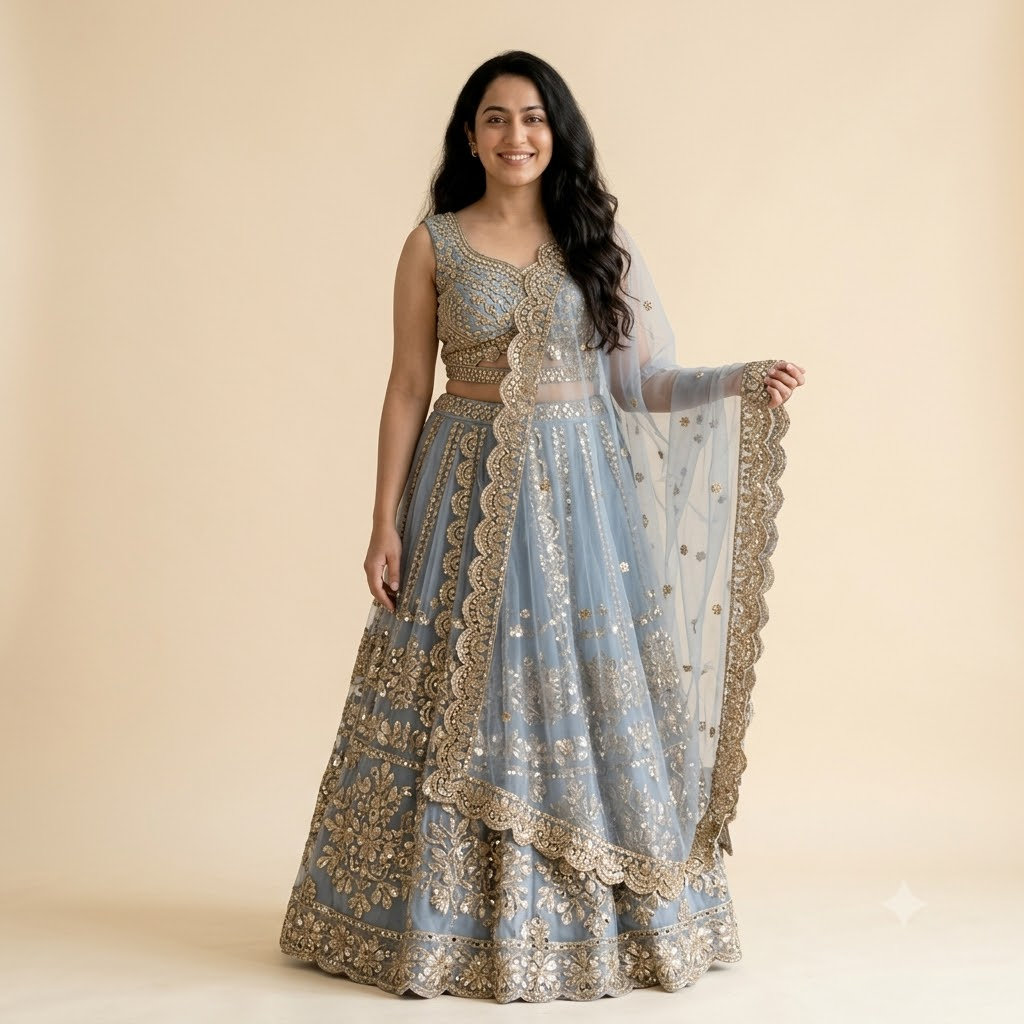
Lehengas and sarees now sit within $2 of each other at the median ($54 against $52), so silhouette is no longer a budget decision. The real structural signal is spread, not level: lehengas run $35–$123 while sarees stay inside $27–$63. Sarees are the predictable choice; lehengas are where both the cheapest and the most expensive pieces live.
Jewellery, all 104 Paksha pieces, all currently in stock:
| Category | Pieces | Range | Median |
|---|---|---|---|
| Mangalsutras | 85 | $34.99 – $339.99 | $74.99 |
| Earrings | 8 | $165 – $927 | $598 |
| Necklaces | 4 | $331 – $968 | $844 |
| Bracelets | 3 | $133 – $530 | $243 |
| Bangles | 2 | $653 – $968 | $810 |
| Hair accessories | 1 | $441 | — |
| Finger rings | 1 | $45 | — |
Mangalsutras dominate by volume and anchor the catalogue’s accessible end. Among the statement categories, earrings are the deepest and also the widest — an eight-piece range spanning $762 means the word “earrings” tells you almost nothing about price. Bracelets are the most accessible statement entry point at a $243 median.
The shipping maths nobody does until it is too late
This is where Diwali plans actually fail, and it is arithmetic rather than taste.
Diwali falls on 8 November 2026. Working backwards from our partners’ stated dispatch times:
- House of Indya dispatches from Delhi in 5–7 business days. Add international transit and customs. Order by 22 October for comfortable US delivery.
- Paksha dispatches from Chennai in 3–5 days, plus 4–6 days customs transit. Order by 20 October.
- Bonheur Jewelry ships US-domestic only — fast for US buyers, unavailable to everyone else. We have not price-indexed Bonheur in this edition because it is not yet in our structured catalogue; treat its inclusion here as a shipping note, not a price claim.
- Embey Vally has the longest dispatch of our partners. If you are combining it with anything else, order it first.
The compounding problem is that two of these are sequential, not parallel. If you are buying an outfit and jewellery from different partners, your binding constraint is whichever arrives last — and there is no consolidated shipping.
The peak search window for Diwali runs 15 October to 5 November. Note that the window opens a week before the recommended order-by date and stays open for three weeks after it. A meaningful share of people searching in that window are already too late for Diwali night and do not yet know it.
Stock behaves differently by partner
Both catalogues currently show 100% in stock — 83 of 83 at House of Indya, 19 of 19 at Paksha. That number will not hold through late October, and the two partners fail differently:
- House of Indya restocks weekly during festive season. A sold-out size is often a one-week wait rather than a dead end.
- Paksha pieces are batch-made and do not restock within a season. When a set sells out it is gone until the following year. This is the single most important behavioural difference between our two main partners, and it inverts the usual advice: with Paksha, buy when you see it.
Four categories nobody is serving
An honest index should name its own gaps. Across our two price-indexed partners:
One deliberate exclusion first. A third partner, Embey Vally, holds 446 costume pieces between $0.20 and $1.03. They are left out of every figure in this report on purpose — folding $0.36 alloy chains into a Diwali budget index would drag every median toward zero and tell you nothing useful about what an outfit costs. They are catalogued at /best/costume-jewellery/ and priced honestly there.
- Menswear is absent. Not under-stocked — absent. Silk kurtas, Nehru jackets, bandhgalas: zero pieces across the 187 indexed items. For a festival where entire families dress, this is the largest single hole in the market we can see.
- Premium jewellery above $968 does not exist in our catalogue. Paksha tops out there. Buyers wanting genuine polki or bridal-weight sets have nowhere to go within this price architecture.
- Sterling jewellery is no longer the expensive half. 63 of Paksha’s 104 pieces sit below the $123 apparel ceiling, and 13 below $50 — the two catalogues overlap across almost their entire range. The old assumption that an outfit is cheap and real silver is a splurge holds only against the 19 statement pieces; against the 85 mangalsutras it is simply false. A $74.99 sterling mangalsutra costs more than the median lehenga, which now sits at $54.
- Bridal is out of scope and should be. Our apparel ceiling is $123. Indian bridal lehengas begin several multiples above that. Anyone positioning this catalogue as bridal is misrepresenting it — the honest framing is sister-of-the-bride, not bride.
What we would tell a first-time buyer
If this is your first Diwali shopping abroad and you want one paragraph rather than six tables: budget $120 to $180 for a complete, genuinely good look. Take a saree set or anarkali in the $28–$46 band, which is the catalogue’s deepest value. Add a sterling mangalsutra in the $55–$99 band, where 34 of the 41 pieces are neck-worn. If you want a statement piece instead, the bracelet tier starts at $133 and earrings at $165 — but neither is necessary to look finished. Order the jewellery first because it does not restock. Place everything by 20 October.
The $138 complete-look median is close to typical here, which was not true of this catalogue a week ago. The 19 statement pieces still run to $968 and will pull any average upward, but they are now a minority of the jewellery on offer rather than the whole of it.
Methodology: price bands computed from 187 individually-catalogued products (83 House of Indya, 104 Paksha) as held in the Style Drops catalogue on 9 October 2026. Embey Vally’s 446 costume pieces are deliberately out of scope: at a $0.36 median they are alloy accessories rather than festive-outfit components, and mixing them into these bands would make every figure meaningless. The 83 House of Indya products are INR-native and converted at 96 INR/USD (frankfurter.dev, 30 September 2026); the 104 Paksha products are source-native USD taken directly from the merchant and are not converted. Stock status as recorded at the same date. Dispatch times are partner-stated. Festival dates and peak-search windows per the Style Drops 2026 festive calendar. No survey, market-size or growth data is used anywhere in this report, and none should be inferred from it.
This edit is being curated. Fresh picks land here on the next drop day (Mon · Wed · Fri).